TL;DR
- On September 14, 2026, a federal judge in Massachusetts blocked the Department of Homeland Security's rule that would have ended “duration of status” (D/S) and capped F-1 student and J-1 exchange visitor stays at four years — the rule was set to take effect the very next day.
- The case: Presidents’ Alliance on Higher Education and Immigration, et al. v. U.S. Department of Homeland Security, et al., No. 1:26-cv-13799 (D. Mass.). The judge: F. Dennis Saylor IV, U.S. District Court for the District of Massachusetts.
- The ruling: a nationwide preliminary injunction. The judge found DHS likely violated the Administrative Procedure Act — brushing past 22,000 public comments (most opposed), never seriously weighing alternatives, and offering a national-security justification the court said “borders on the absurd.”
- What changes today: nothing. D/S stays in place, nationwide, for now.
- What this isn’t: a final win. It’s a preliminary injunction — DHS can appeal, and the case continues, with a status conference set for October 2. Read the official case docket yourself if you want the judge’s reasoning in full.
I read this one twice before I believed the timing. The rule DHS finalized this summer was scheduled to take effect on September 15. The judge blocked it on September 14 — the night before. If you sponsor F-1 students or J-1 exchange visitors and you’d already started bracing for Monday, you can exhale. For now.
Here’s what actually happened, and — because I know how this topic gets flattened into “students win, Trump loses” headlines — here’s what it does and doesn’t mean.
What “duration of status” is, and why DHS wanted to end it
For nearly fifty years, F-1 students and J-1 exchange visitors have been admitted for “duration of status” — meaning their authorized stay runs for as long as they’re actively pursuing their program, not a fixed expiration date stamped at the border. It’s the reason a PhD candidate whose research runs six years instead of five doesn’t suddenly become “out of status” through no fault of their own.
DHS’s rule, finalized this summer, would have scrapped that. In its place: a fixed period of admission — four years, or the length of the program, whichever is shorter — plus a 30-day grace period to leave. Need more time? File for an Extension of Stay with USCIS and show “compelling” circumstances, with a 240-day automatic extension while that application sits in the queue. Graduate students would have been locked out of changing degree level or major entirely; undergrads, for their first year. It covered F-1 students, J-1 exchange visitors (including postdocs, researchers, and Fulbright scholars), and I-visa foreign media.
I sponsor roughly 30 of these petitions a year myself, so I don’t say this lightly: this would have turned routine program delays — a lab reagent shipment stuck in customs, a dissertation defense pushed six weeks, a funding gap between semesters — into immigration emergencies. Not hypothetically. Routinely.
Why the judge blocked it
The plaintiffs — a coalition of eight higher-ed and advocacy organizations, including the Presidents’ Alliance on Higher Education and Immigration and NAFSA: Association of International Educators — sued DHS on August 18, arguing the rule was arbitrary and capricious under the Administrative Procedure Act.
Judge Saylor agreed, at least for now. The opinion doesn’t mince words. On DHS’s stated national-security rationale, he wrote that the argument “borders on the absurd,” built on “a small handful of anecdotes” rather than any real analysis. Elsewhere: “I am struggling to see any real, rational connection between national security issues identified…and this change.” The agency, he found, likely never grappled seriously with the roughly 22,000 comments it received during the rulemaking process — most of them opposed — and never meaningfully considered less disruptive alternatives, which the APA requires it to do.
That’s a preliminary injunction, not a final ruling on the merits. But when a federal judge says your government’s stated justification borders on absurd, “we expect to win eventually” is not a confident place for DHS to be standing.
What this means for you right now
If you’re at a university, research institute, hospital, or any organization that sponsors F-1 or J-1 status: nothing changes today. Duration of status is still the rule. Don’t file anything differently, don’t panic your international students and scholars, and don’t let anyone tell you the fixed four-year clock is already running — it isn’t.
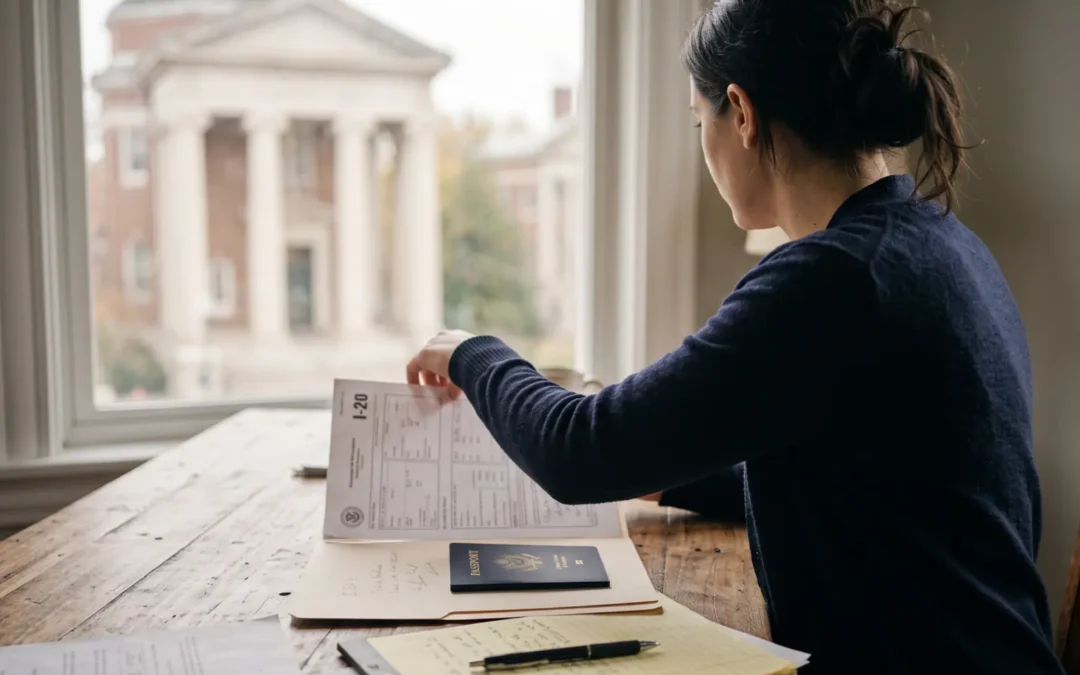
What I would do: keep an eye on October 2, when the parties are back in front of Judge Saylor for a status conference, and don’t treat this as fully resolved. DHS has already shown it wants this rule; a preliminary injunction slows it down, it doesn’t kill it. If you advise international students or scholars, this is a good moment to remind them that D/S is intact — and to keep their I-20s and DS-2019s current regardless, because that paperwork discipline was never optional in the first place.
And if you’re outside higher ed — J-1 also covers physician exchange programs, corporate trainee visas, au pair sponsors, and government and cultural exchange programs — this ruling reaches you too. “Duration of status” isn’t a university-only concept; it’s the framework underneath every J program in the country.
Sources and official documents
- Official case docket — Presidents’ Alliance on Higher Education and Immigration, et al. v. DHS, et al., No. 1:26-cv-13799 (D. Mass.), via CourtListener, the free federal court records archive run by the nonpartisan Free Law Project. The September 14, 2026 Memorandum and Order on the Motion for Preliminary Injunction, and the original complaint, are both filed on this docket.
- Stuart Anderson, “Judge Blocks Immigration Rule Limiting Students To Four Years,” Forbes, Sept. 15, 2026
- “Judge Blocks Controversial International Student Restrictions,” Inside Higher Ed, Sept. 14, 2026
- “Judge blocks Trump administration plans to limit visa length for grad students, postdocs,” STAT News, Sept. 14, 2026
- “Judge blocks DHS rule limiting foreign students to four-year stays,” The Washington Post, Sept. 14, 2026
- “Federal Judge Temporarily Blocks Four-Year Student Visa Cap,” The Harvard Crimson, Sept. 14, 2026
- DHS rule change summary, Harvard International Office
This is a moving legal situation. The facts above are accurate as of publication (September 15, 2026) — check the case docket, No. 1:26-cv-13799 (D. Mass.), before relying on this for a specific filing decision, and talk to your institution’s immigration counsel about anything time-sensitive.